Best Times to Enter Crypto Trades: Timing Your Entries

Unlike traditional markets, crypto trades 24 hours a day, 7 days a week. But not all hours are created equal. Learn when volume peaks, which sessions produce the strongest moves, and how to time your entries for optimal results.

Why Timing Matters in Crypto Trading

One of the biggest misconceptions among new crypto traders is that because the market never closes, every hour is equally good for trading. This could not be further from the truth. While the crypto market technically operates around the clock, trading volume, volatility, and institutional participation fluctuate dramatically depending on the time of day.

The difference between entering a trade during peak volume hours versus a dead zone can be the difference between a clean breakout that hits your take-profit and a choppy, range-bound mess that slowly bleeds your position through fees and frustration. Understanding crypto market hours and session dynamics is one of the most overlooked edges in retail trading.

Professional traders have known this for decades in forex and equities. The same principles apply to crypto, with a few important differences. In this guide, we will break down the three major trading sessions, explain when the best entry windows occur, and show you how to use AI-powered tools to optimize your timing regardless of when you are available to trade.

The Three Major Crypto Trading Sessions

Crypto volume follows traditional financial centers. Understanding these windows is essential for timing entries.

Asian Session

00:00 - 08:00 UTC. Lowest volume of the day. Price tends to consolidate and accumulate. Range-bound trading dominates. Good for identifying accumulation zones and setting up entries for the next session's breakout. South Korea and Japan drive most of the activity.

European Session

08:00 - 16:00 UTC. Volume picks up significantly as London and Frankfurt open. Breakouts from Asian session ranges often begin here. Institutional traders start positioning. This is where you often see the first directional move of the day as European capital enters the market.

US Session

14:00 - 22:00 UTC. Highest volume, strongest directional moves. Wall Street participation drives massive liquidity. The US-European overlap (14:00-16:00 UTC) is the single most active window for crypto trading, producing the cleanest breakouts and heaviest volume candles.

The Power of Session Overlaps

The most important concept in crypto market hours is the session overlap. When two major sessions are active simultaneously, combined liquidity creates the ideal conditions for strong directional moves. The European-US overlap from 14:00 to 16:00 UTC consistently produces the highest volume bars on most crypto pairs. This is when institutional order flow from both regions collides, creating the kind of clean price action that technical traders depend on.

There is also a smaller overlap between the Asian and European sessions around 07:00-08:00 UTC. While less dramatic, this transition period often marks the moment when Asian session ranges finally break, making it a secondary window for breakout entries. Experienced traders who understand these crypto volatility hours have a significant edge over those who enter trades at random times.

AUTO-CAPTURE

AI Analyzes Charts Whenever You Are Ready

You do not need to be awake at 14:00 UTC to catch the best setups. ChartsTrack's auto-capture feature grabs your TradingView charts automatically and runs them through AI analysis regardless of the time. The AI considers current market conditions, including volume levels and session context, when generating trade setups.

Whether you are scanning during the quiet Asian session or the explosive US open, the AI adapts its analysis to the conditions at hand. It understands that a breakout setup during high-volume US hours carries different probability than the same pattern during low-volume Asian consolidation.

  • 24/7 availability — analyze charts from any session at any time
  • Session-aware AI — considers current volume and volatility context
  • Auto-capture from TradingView — no manual screenshots needed
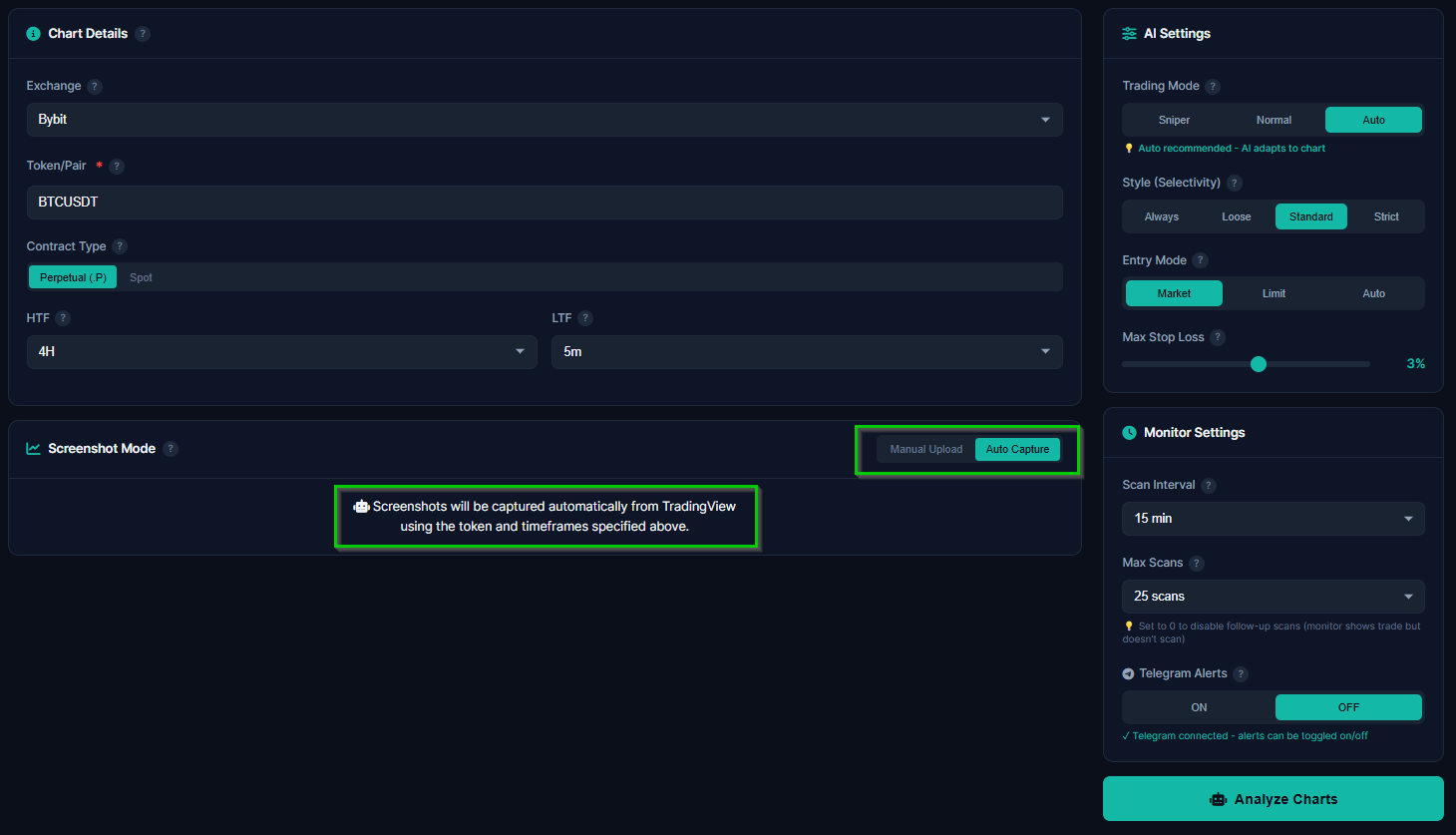
Auto-capture TradingView charts for crypto analysis at any time
SELECTIVITY

Selectivity Settings Matter for Different Sessions

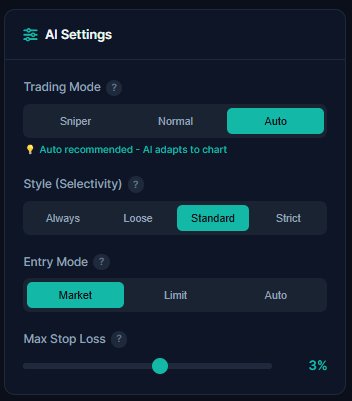
One of the most powerful but underused features on ChartsTrack is the selectivity setting. This directly affects how strict the AI is when deciding whether a chart warrants a trade setup. And the optimal selectivity level changes depending on when you are trading.

During low-volume Asian hours, consider using Strict selectivity. This requires 2 or more strong confluences before the AI will suggest a trade, filtering out marginal setups that are more likely to chop around in thin liquidity. During high-volume US and European session hours, you can switch to Standard or Loose selectivity to capture breakout moves that have strong volume confirmation behind them.

  • Strict — best for Asian session, requires multiple confluences
  • Standard — balanced, great for European session entries
  • Loose — catches more setups during high-volume US hours
  • Auto — let AI decide based on current conditions
AI selectivity settings for trading style and mode configuration

Best Entry Signals: What to Look For

Regardless of which session you are trading, certain entry signals consistently produce higher-probability trades. The best time to enter a crypto trade is not just about the clock — it is about the confluence of technical factors that align at that moment.

Multi-Timeframe Confluence

The strongest entries occur when both the higher timeframe (HTF) and lower timeframe (LTF) agree on direction. If the 4H chart shows a clear downtrend with lower highs, and the 15-minute chart just broke below a consolidation range, you have genuine multi-timeframe alignment. ChartsTrack analyzes both timeframes simultaneously to identify exactly these setups.

Volume Confirmation

A breakout without volume is just a fakeout waiting to happen. The best entries come when price breaks a key level accompanied by above-average volume. This is why session timing matters so much — breakouts during the US session naturally have more volume backing them, reducing the probability of false breaks.

Key Level Bounces

Support and resistance levels that have been tested multiple times become increasingly significant. When price bounces off a well-established support level during a high-volume session, the probability of that level holding is substantially higher than during thin Asian hours. Understanding support and resistance dynamics is fundamental to optimal entry timing.

Pattern Completions

Chart patterns like head and shoulders, double bottoms, and wedge breakouts are most reliable when they complete during active trading hours. A wedge breakout at 3 AM UTC is far less trustworthy than one that completes at 15:00 UTC during peak liquidity. The pattern itself might be identical, but the market context surrounding it determines the outcome.

CONFIRMATION

Wait for Confirmation Before Entering

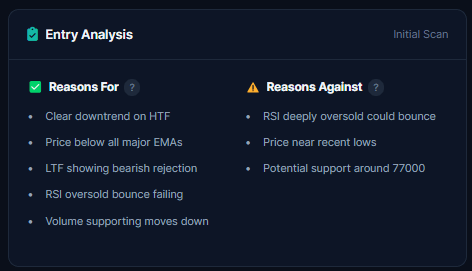
The number one reason traders lose money on entries is FOMO — fear of missing out. They see price moving and jump in without waiting for the setup to fully develop. ChartsTrack's entry analysis combats this by showing you explicit Reasons For and Reasons Against every trade setup.

When the Reasons For column is stacked with 5 or more strong confluences and the Reasons Against are minimal, you have a confirmed entry. When Reasons Against are significant — oversold conditions, nearby resistance, counter-trend structure — the AI is telling you to wait or skip the trade entirely.

  • Strong entry — 5+ Reasons For, 1-2 minor Reasons Against
  • Cautious entry — 4 Reasons For, 3 significant Reasons Against
  • Skip — when Reasons Against outweigh or include structural warnings

Learning to read an honest entry analysis will dramatically improve your timing and help you avoid the impulsive entries that destroy trading accounts.

AI entry analysis showing reasons for and against crypto trade entry

When NOT to Enter a Crypto Trade

Knowing when to stay out of the market is just as important as knowing when to enter. Some of the most expensive trading mistakes come from entering at the wrong time, not from wrong analysis. Here are the situations where even a perfect technical setup should give you pause.

During Major News Events

FOMC interest rate decisions, CPI inflation reports, major regulatory announcements, and unexpected geopolitical events can override any technical setup in seconds. Crypto is especially reactive to US Federal Reserve decisions and regulatory news. Check the economic calendar before entering any trade, and avoid entering within 30 minutes before or after major scheduled events.

Right at Session Open or Close

The first and last 15 minutes of each major session can produce erratic price action as market makers adjust positioning. The US session open (14:00 UTC) and stock market close (20:00-21:00 UTC) are particularly volatile. Wait for the initial chaos to settle before entering — let the first 15-minute candle close, then assess the direction.

When the AI Says "No Trade"

ChartsTrack does not generate a trade setup for every chart you submit. When the AI determines there is no valid setup — insufficient confluence, conflicting timeframes, or poor risk-reward — it explicitly returns a No Trade result with detailed reasoning. Trust this assessment. One of the most common trading mistakes is forcing a trade when none exists.

When Confidence Is Below 70%

If the AI generates a setup but assigns a confidence score below 70%, the trade has significant risks that outweigh the potential reward. These Class C (60-69%) setups can work, but they require tighter position sizing and aggressive risk management. For most traders, especially beginners, sticking to Class A (80%+) and Class B (70-79%) setups during peak session hours produces the best long-term results.

Key Takeaway

The best entries come from patience, not speed. Let the setup come to you. Wait for the right session, confirm multi-timeframe confluence, and only enter when the risk-reward justifies the trade. Traders who master timing consistently outperform those who simply chase price action at random hours. The crypto market will always be there tomorrow — your capital might not be if you rush into bad entries today.

Common Questions About Crypto Entry Timing

What is the best time of day to trade crypto?

The best time to trade crypto is during the US-European session overlap (14:00-16:00 UTC), when trading volume is highest and price movements are strongest. This overlap combines institutional activity from both regions, creating cleaner breakouts and more predictable technical patterns. However, the "best" time also depends on your strategy — range traders may prefer the quieter Asian session, while breakout traders thrive during US hours.

Should I avoid trading crypto during the Asian session?

Not necessarily. The Asian session (00:00-08:00 UTC) has lower volatility and volume, which can actually be good for accumulation-style entries and range trading. The key is adjusting your strategy: use tighter targets and higher selectivity during Asian hours, and save aggressive breakout trades for the European or US sessions. ChartsTrack's selectivity settings let you configure this automatically.

Does ChartsTrack work during all trading sessions?

Yes. ChartsTrack's AI chart analysis and trade monitoring work 24/7 regardless of the trading session. The AI automatically considers current market conditions including volatility and volume levels when generating trade setups. You can use the selectivity settings to be stricter during low-volume periods and looser during high-volume breakout sessions.

Related Articles

Time Your Entries with AI Precision

Stop guessing when to enter. Let ChartsTrack's AI analyze your charts and tell you exactly when the setup is confirmed.