7 Common Trading Mistakes and How AI Helps You Avoid Them

Most traders make the same predictable mistakes over and over. No stop loss, FOMO entries, emotional exits, overtrading. Here is how each mistake works, why it happens, and how systematic AI analysis breaks the cycle.

The Same Mistakes, Over and Over

If you have been trading crypto for more than a few months, you have probably noticed something uncomfortable: the mistakes that cost you money are not random. They are the same ones, repeating on a cycle. You tell yourself "never again" after a particularly painful loss, then find yourself doing the exact same thing two weeks later.

This is not a personal failing. It is human psychology. Trading environments are specifically designed to trigger emotional responses -- fear, greed, FOMO, revenge -- that lead to predictable errors. The flashing numbers, the unrealized P&L, the time pressure -- all of it pushes you toward decisions that feel right in the moment but are statistically destructive over time.

The good news is that because these mistakes are predictable, they are also preventable. Not through willpower (which is finite and fails under stress), but through systems that make the right behavior the default behavior. Let us walk through the seven most common trading mistakes and how AI-powered analysis addresses each one.

Mistake #1: Trading Without a Stop Loss

This is the single most destructive mistake in trading. No stop loss means unlimited downside risk. A trader enters a long position, price drops 5%, and they think "it will bounce back." It drops 10% and they are frozen. 20% and they are in too deep to exit. One trade can destroy an entire account.

Why do traders skip the stop loss? Three reasons. First, they believe they will "manage it manually" and exit if it goes bad. They will not. Emotional attachment to the position makes it nearly impossible to click the close button at a loss. Second, they have been burned by stop losses that get hit right before price reverses. This feels like the market is hunting them personally (it is not -- they are placing SL at obvious levels). Third, they use mental stop losses instead of actual orders. Mental stops are not real stops. They are wishes.

How ChartsTrack prevents this: Every trade setup generated by ChartsTrack includes a calculated stop loss placed at a technically meaningful level -- behind support, below swing lows, above resistance. The SL is not arbitrary; it is the price at which the trade thesis is genuinely invalidated. There is no option to generate a trade setup without a stop loss. The discipline is built into the system itself.

Mistake #2

Ignoring Risk-Reward Ratios

Many traders evaluate setups purely on whether they think price will go up or down. They never ask the more important question: how much can I make versus how much can I lose?

A trade with a $500 stop loss and a $200 target is a terrible trade even if you are 80% sure about the direction. You need to win more than 71% of the time just to break even at that ratio. Over hundreds of trades, that math is brutal.

ChartsTrack displays every trade setup with clearly defined entry, SL, TP1, and TP2 levels. You can see the exact risk-reward ratio before you enter. TP1 typically sits at approximately 1:1 RR (partial profit lock), while TP2 targets 2:1 or better. If the AI cannot find a setup with acceptable risk-reward, it will tell you -- it does not force trades with poor math just to give you something to do.

  • TP1 at ~1:1 RR: Close 50% and lock in profit early
  • TP2 at 2:1+ RR: Let remaining 50% run for maximum gain
  • Effective combined RR: 1:1.5 to 1:3+ across the full position
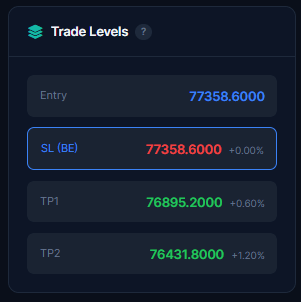
ChartsTrack trade levels showing entry, stop loss, TP1, and TP2 with clear risk-reward ratios

Mistake #3: FOMO Entries -- Chasing Pumps Without Analysis

The token just pumped 15% in an hour. Twitter is screaming about it. Your portfolio is flat while everyone else is making money. The FOMO (Fear Of Missing Out) is overwhelming. So you buy at the top of a massive green candle with no analysis, no stop loss, and no plan. Then it corrects 8% in the next two hours and you are stuck holding a bag.

FOMO entries are some of the worst trades a human can make because they violate every principle of sound trading: no analysis (you are reacting to price movement, not chart structure), no risk management (you did not plan SL or TP levels), and terrible timing (you are buying exactly when early buyers are selling to you).

How ChartsTrack prevents this: The AI does not have emotions. It does not feel FOMO. When you upload a chart of a token that just pumped 15%, the AI analyzes the structure objectively. If the chart shows exhaustion, overbought conditions, and no clear support for an entry, it will tell you. If there is actually a valid setup with proper risk-reward, it will generate one with appropriate levels. Either way, you get an objective assessment instead of an emotional reaction.

Mistake #4

Ignoring Warning Signs and Red Flags

Confirmation bias is one of the most dangerous cognitive biases in trading. Once you have decided you want to take a trade, your brain actively filters information to support that decision and dismisses anything that contradicts it. You see the bullish divergence but not the massive resistance zone above. You notice the breakout but ignore the declining volume.

This selective attention costs traders enormous amounts of money because the warning signs they ignore are often the exact factors that cause the trade to fail.

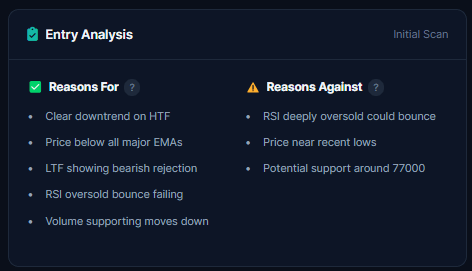
ChartsTrack's entry analysis is specifically designed to counteract confirmation bias by presenting both sides of every trade setup:

  • Reasons For: 5-7 specific technical observations supporting the trade direction. These are the factors that make the setup attractive
  • Reasons Against: 2-4 honest risks and red flags that could invalidate the trade. These are the factors your brain would normally filter out

Seeing both sides does not mean avoiding the trade. It means entering with full awareness of the risks, which leads to better position sizing, better stop loss placement, and better psychological preparedness if the trade moves against you.

ChartsTrack honest entry analysis showing Reasons For and Reasons Against a trade setup

Mistake #5: Overtrading -- Taking Every Setup You See

Overtrading is driven by the belief that you need to always be in a position to make money. Every chart looks like an opportunity. Every pullback is a potential entry. You take 10 trades a day when only 1-2 actually have genuine edge.

The math of overtrading is devastating. Each trade has a cost (spreads, fees, slippage). Marginal trades with weak setups have lower win rates. More trades mean more emotional decisions, more fatigue, and more mistakes. The compounding effect of these small disadvantages turns what could be a profitable month into a losing one.

How ChartsTrack prevents this: The AI has a configurable selectivity setting (Always, Loose, Standard, Strict). On Standard or Strict settings, the AI requires multiple confluences across timeframes before generating a trade setup. When the chart does not meet the quality threshold, ChartsTrack returns a clear "No Trade" assessment with specific reasons why the setup is not worth taking.

This "No Trade" response is one of ChartsTrack's most valuable features. It is much easier to skip a trade when you have an objective, AI-generated explanation for why the setup is weak, compared to trying to convince yourself through pure willpower.

Mistake #6

No Trade Journal: Repeating Mistakes You Cannot See

Without a record of your trades, you have no way to identify patterns in your behavior. You cannot answer basic questions like: What is my actual win rate? Which token pairs am I best at trading? Do my morning trades perform better than evening trades? Am I more profitable on AI-generated setups or manual entries?

Most traders skip journaling because it is tedious. Opening a spreadsheet after every trade, logging the details, adding notes -- it adds friction that most people eventually abandon.

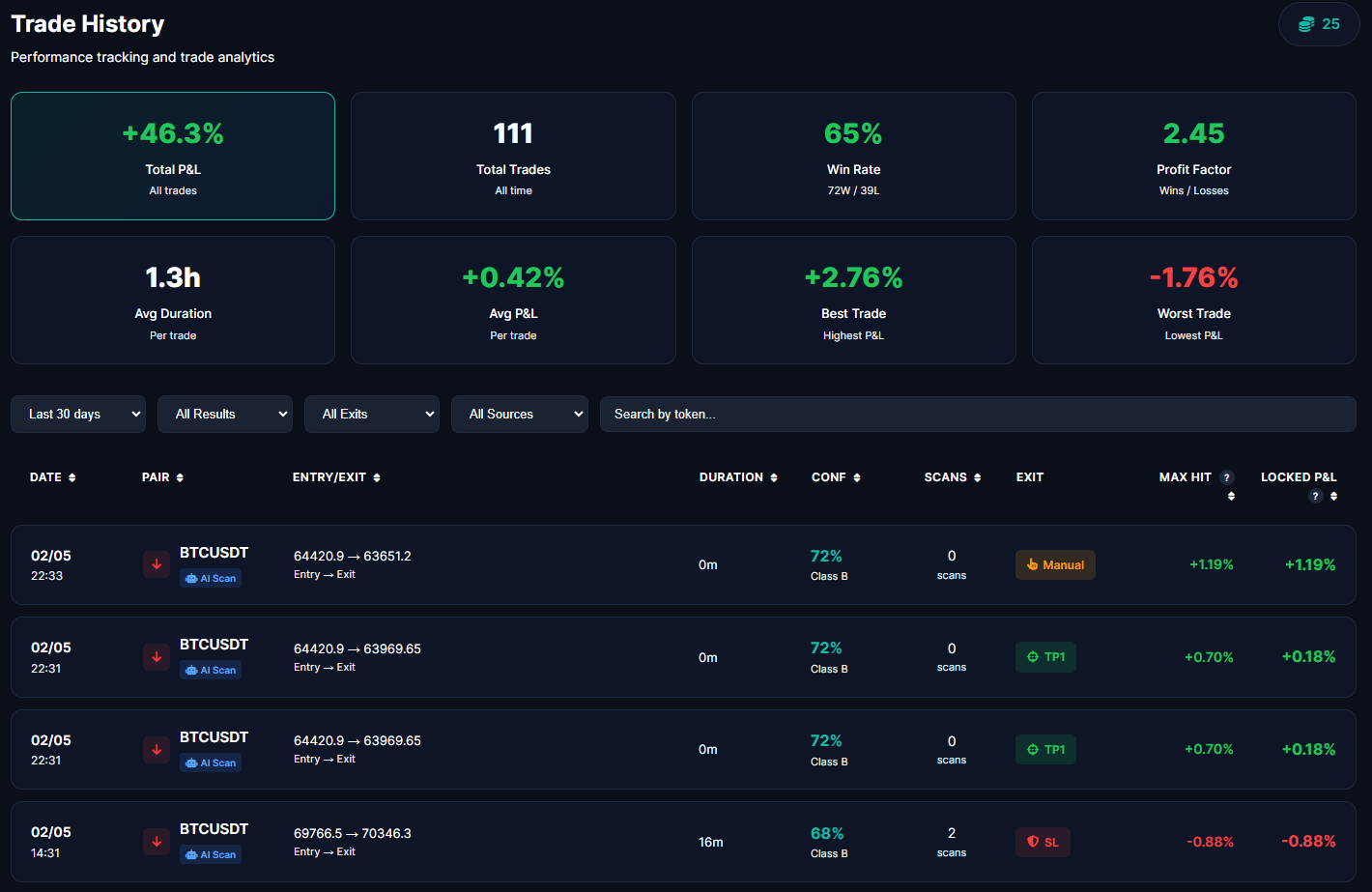
ChartsTrack's trade history automatically logs every monitored trade with comprehensive statistics:

  • Total P&L and win rate: Your overall performance at a glance, with filtering by time period, result type, exit type, and trade source
  • Profit factor: Gross profit divided by gross loss. Above 1.0 means you are profitable. Above 1.5 means you have strong edge
  • Average duration: How long your trades typically run. Helps identify if you are exiting too early or holding too long
  • Best and worst trades: The full range of your outcomes, helping you understand your risk profile
  • Source filtering: Compare AI-generated trades vs manual entries to see which approach delivers better results for you

Automatic tracking removes the friction that kills manual journaling habits. Every trade is recorded with full details, and the statistics recalculate in real time as you apply different filters.

ChartsTrack trade history dashboard showing automated trade journaling with statistics and filters

Mistake #7: Emotional Exit Timing -- Holding Losers, Cutting Winners

This is the mistake that ties everything together. You hold losing trades too long because admitting you were wrong is psychologically painful. You cut winning trades too short because the fear of giving back unrealized profits is overwhelming. The net result: your average loss is larger than your average win, which makes long-term profitability mathematically impossible even with a decent win rate.

Behavioral finance calls this the disposition effect, and it affects virtually every trader to some degree. The only reliable solution is removing human discretion from the exit process as much as possible.

ChartsTrack addresses this through multiple layers:

When the AI says "HOLD," you can hold with confidence because you know something with no emotional stake is watching the chart. When it says "EXIT," you have an objective reason to close the position rather than agonizing over the decision yourself.

The Best Trade Is Sometimes No Trade at All

Not every chart has a tradeable setup. Not every day has an opportunity. The ability to look at a chart and say "there is nothing here worth risking my capital on" is one of the most profitable skills a trader can develop. ChartsTrack's AI will tell you when a chart does not meet the threshold for a quality setup. That single piece of honesty -- the willingness to say "no trade" instead of forcing something -- can save you more money over a year than any entry technique.

The AI Solution

How ChartsTrack Prevents All Seven Mistakes

Every feature in ChartsTrack maps directly to one or more of these common trading mistakes. The platform is not designed to predict the market perfectly -- no system can do that. It is designed to enforce the discipline that prevents predictable, avoidable losses:

  • No stop loss: Every setup includes a calculated SL. You cannot generate a trade without one
  • Bad risk-reward: Trade levels show exact RR. Setups with poor math are filtered out
  • FOMO entries: AI analysis is objective and emotion-free. It does not care what Twitter says
  • Ignoring red flags: Reasons Against section forces you to see both sides
  • Overtrading: "No Trade" assessments with clear reasoning prevent low-quality entries
  • No journal: Automatic trade history with comprehensive statistics
  • Emotional exits: AI monitoring with HOLD/EXIT/MOVE_SL recommendations and confidence tracking

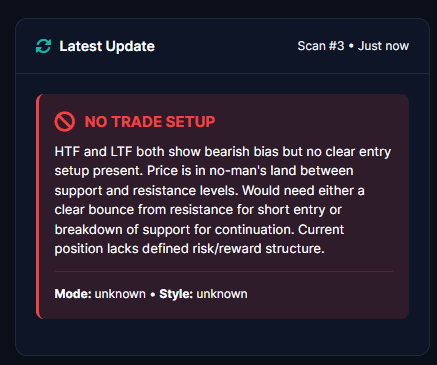
The screenshot shows a real "No Trade" assessment. The AI analyzed the chart and determined the setup did not meet quality standards. Instead of giving you a mediocre trade that loses money, it explains exactly why this is not a good entry. This honest assessment is worth more than any signal.

ChartsTrack No Trade assessment showing AI reasoning for why the chart does not have a valid setup

Common Questions About Trading Mistakes

What is the most common mistake crypto traders make?

The most common and most destructive mistake is trading without a stop loss. When traders enter positions without a predefined exit point for losses, a single bad trade can wipe out weeks or months of profits. ChartsTrack automatically calculates and includes a stop loss with every trade setup based on technical analysis and market structure, making it impossible to accidentally skip this critical step.

How do I stop overtrading in crypto?

Overtrading is caused by the urge to always be in a position. The solution is having an objective filter that tells you when NOT to trade. ChartsTrack's AI will return a "No Trade" assessment when chart conditions do not meet the quality threshold for your selected trading style (Standard or Strict selectivity). Seeing a clear, data-backed reason why a setup is not worth taking is far more convincing than trying to talk yourself out of a trade through willpower alone.

Why do traders lose money even with good analysis?

Good analysis can identify high-probability setups, but traders still lose money due to poor execution: entering too early or too late, using wrong position sizes, moving stop losses further away, exiting winners too quickly, and holding losers too long. These are execution and psychology problems, not analysis problems. AI-assisted trading helps bridge this gap by providing structured trade parameters (entry, SL, TP1, TP2) and continuous monitoring that keeps you disciplined throughout the entire trade lifecycle from entry to exit.

Related Articles

Build the discipline and knowledge to avoid costly trading errors

Stop Making the Same Mistakes

ChartsTrack's AI enforces the discipline that prevents predictable losses. Automatic stop losses, honest analysis, "No Trade" assessments, and continuous monitoring. Let the system handle the psychology.