How AI Improves Your Exit Timing: Hold Winners, Cut Losers

Entering a trade is easy. Exiting at the right time is what separates profitable traders from everyone else. Learn how continuous AI monitoring transforms your exit decisions from emotional reactions into data-driven choices.

The Exit Problem: Why Getting Out Is Harder Than Getting In

Ask any experienced trader what the hardest part of trading is, and most will not say finding entries. They will say managing exits. Finding a chart pattern, identifying a support level, and clicking "buy" or "sell" -- that part is relatively straightforward. The agony comes after, when you are in the trade and every tick of price movement triggers an emotional response.

The trade moves in your favor and you think: "Should I take profit now before it reverses?" You close too early and watch it run another 5% without you. The trade moves against you and you think: "It will come back. I just need to hold." You watch a small loss grow into a devastating one.

This pattern has a name: disposition effect. Behavioral finance research shows that traders consistently cut winners too short (fear of giving back gains) and hold losers too long (hope of recovery). The result is small wins and large losses -- the exact opposite of what profitable trading requires.

The solution is not more willpower. Willpower fails under stress. The solution is a systematic, emotion-free exit framework that monitors market conditions continuously and makes recommendations based on evidence rather than feelings. That is exactly what ChartsTrack's AI monitoring provides.

Continuous Analysis

AI Re-Analyzes Every Scan Interval

Most traders check their trades when they feel like it -- when they are anxious, bored, or just saw a notification. This random, emotion-driven monitoring leads to reactive decisions rather than proactive management.

ChartsTrack's AI monitoring works on a fixed schedule. At every scan interval (configurable from 5 minutes to 1 hour), the AI captures fresh screenshots of both your HTF and LTF charts and performs a complete re-analysis. After every scan, you receive a clear, actionable recommendation:

  • HOLD: The trade thesis remains intact. Structure is holding, trend is continuing, and there are no significant warning signs. Stay in the position and let it work
  • EXIT: The trade thesis has been invalidated. Market structure has changed, the pattern has failed, or conditions have deteriorated significantly. Close the position to protect capital
  • MOVE_SL: Conditions have improved enough to tighten your stop loss. Lock in more profit by moving SL closer to current price or to breakeven after TP1

Each recommendation comes with detailed reasoning explaining what the AI is seeing on the charts and why it is making that specific recommendation. You are never blindly following a signal -- you understand the logic behind every suggestion.

Importantly, the system includes a two-scan close confirmation safety mechanism. When the AI first wants to recommend EXIT, that first request is converted to a HOLD with a pending close flag. Only if the AI confirms the exit on the next scan does it become a real EXIT recommendation. This prevents impulsive exits based on temporary price spikes or single-candle noise, ensuring only sustained deterioration triggers an actual close signal.
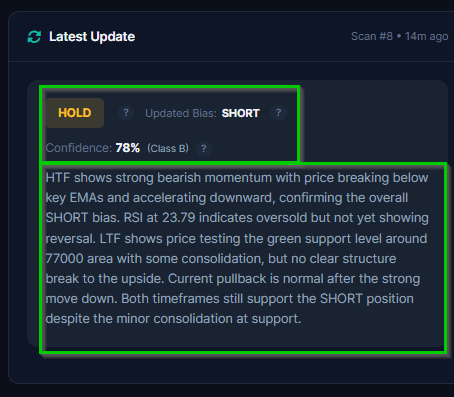
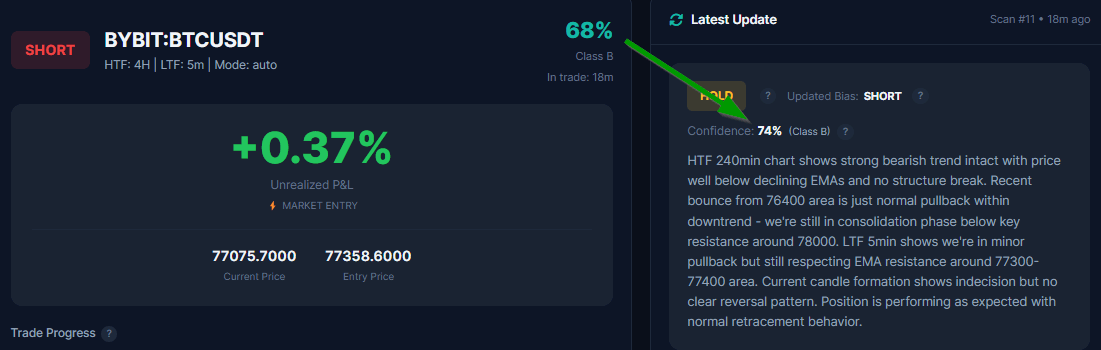
ChartsTrack latest AI update showing detailed analysis and HOLD recommendation with reasoning
Early Warning

Confidence Tracking: The Early Warning System

Every trade starts with a confidence score based on the quality of the setup. An 85% confidence trade has strong multi-timeframe alignment, clear trend structure, and high pattern quality. But markets are dynamic. What starts as a strong setup can deteriorate as conditions change.

ChartsTrack tracks confidence across every scan, creating a visible trend that tells you whether your trade is strengthening or weakening:

  • Rising confidence (85% to 92%): The trade is working as expected. Price action is confirming the original thesis. Structure is strengthening on both timeframes. This is the green light to hold with conviction
  • Stable confidence (85% to 82%): Normal fluctuation. The trade thesis is intact with minor noise. No action needed
  • Dropping confidence (85% to 68%): Warning signal. Something has changed. Maybe the LTF is showing weakness, or an important level was lost. Pay close attention and consider tightening your stop loss
  • Significant drop (85% to 50%): Serious deterioration. The original trade thesis is largely invalidated. Consider exiting immediately rather than waiting for your stop loss to be hit

This confidence evolution gives you something no signal provider offers: a quantified, continuously-updated measure of how the AI's conviction in your trade is changing. You can make exit decisions proactively based on deteriorating conditions rather than reactively after a large loss.

Confidence score evolution chart showing AI conviction dropping from 85% to 68% as trade conditions change
Profit Protection

Automatic TP1 Profit Lock: Never Give Back Everything

The fear of giving back profits is one of the primary reasons traders exit winners too early. You are up 3% and thinking: "What if it reverses? I should take this profit now." So you close the entire position and watch it continue to your original target without you.

ChartsTrack's multi-TP system solves this psychological conflict elegantly:

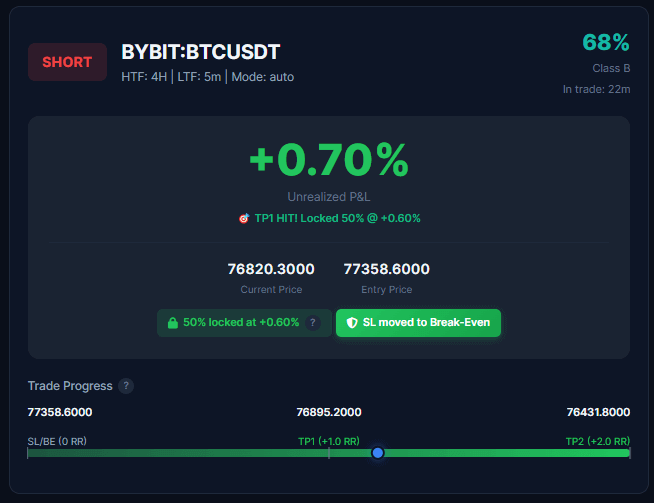
  • TP1 hit: 50% of your position is closed automatically. You have locked in real, tangible profit that cannot be taken away. The fear of "giving it all back" is immediately neutralized because you have already banked gains
  • SL moves to breakeven: The remaining 50% now has zero downside risk. Even if price reverses completely, you walk away with the TP1 profit intact
  • TP2 target: With profits secured and the remaining position risk-free, you can let the winner run without the psychological pressure that causes premature exits

This system addresses both sides of the exit timing problem. You take partial profits early enough to satisfy the fear of reversal, but you keep enough position open to capture the larger move. It is a mathematical framework for the emotional problem of exit timing.

After TP1, the system activates an RR-level trailing stop for the remaining 50%. Instead of a fixed trailing distance, the stop-loss progressively advances through risk-reward levels (1R, 1.5R, 2R, etc.) as price moves further in your favor. If the trade eventually reverses, you exit at the highest RR level reached rather than giving back everything to TP1. This dynamic trailing captures significantly more profit on strong runners.

There is also a built-in 50% early exit protection: the system physically prevents the AI from closing a trade before price has moved at least 50% of the distance toward either your SL or TP1. This ensures every trade gets a fair chance to develop in the critical early phase, eliminating the most common source of missed winners — premature exits when the trade simply needed more time.

Trade showing TP1 hit with automatic 50% profit lock and stop loss moved to breakeven
Structure Breaks

Structure Break Detection: Exit Before the Damage

Your stop loss is your last line of defense. It protects you from catastrophic loss. But ideally, you want to exit a failing trade before price reaches your stop loss, not after. This is where structure break detection becomes incredibly valuable.

A structure break occurs when the market behavior that supported your trade thesis fundamentally changes. Examples include:

  • Trend break: A higher low is violated in an uptrend, or a lower high is broken in a downtrend. The sequence that defined the trend is no longer intact
  • Support/resistance failure: A key level that was expected to hold breaks with conviction, invalidating the trading range or pattern you were trading
  • Momentum shift: Volume and momentum indicators flip against your position, suggesting the underlying buying or selling pressure has changed direction
  • Timeframe conflict: The LTF starts moving against the HTF trend, or the HTF trend itself begins to deteriorate while you are in a trade

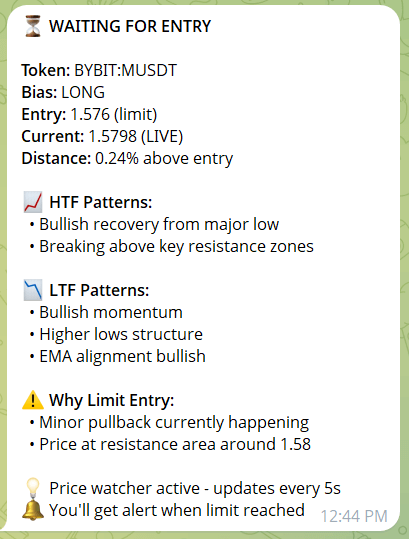
When ChartsTrack's AI detects a structure break, it sends an immediate Telegram alert explaining what broke and why it matters. This gives you the opportunity to exit at a better price than your stop loss, saving capital that would otherwise be lost to the full SL distance.

Telegram alert showing AI-detected structure break warning with explanation of what changed

Common Exit Mistakes That Destroy Profitability

Even traders who understand entry analysis and risk management often sabotage themselves with poor exit decisions. Here are the most common exit timing mistakes and how systematic AI monitoring prevents each one:

Mistake 1: Moving Your Stop Loss Further Away

When price approaches your SL, the temptation to "give it more room" is overwhelming. But moving your SL further away increases your risk on a trade that is already going against you. It transforms a controlled, predefined loss into an open-ended one. ChartsTrack's system never moves your SL further from entry -- it only moves toward profit (to breakeven after TP1, or trailing in your favor).

Mistake 2: Closing Winners at the First Sign of Pullback

A healthy trade will pull back. That is normal. Closing your entire position at the first red candle means you will never capture a significant move. The multi-TP system solves this: you take partial profit at TP1 (satisfying the urge to "do something") while letting the remainder run with a breakeven stop loss (eliminating the fear of total loss).

Mistake 3: Holding Through Clear Reversals

When the AI drops from 85% confidence to 55% and you have clear structure breaks on both timeframes, the correct action is to exit. Holding because "it might come back" is not a strategy -- it is hope. The confidence tracking and structure break alerts give you objective reasons to exit before sentiment-driven hope costs you more capital.

Mistake 4: Revenge-Holding Losers

After a string of losses, traders often refuse to take the next stop loss because they are emotionally exhausted from losing. "This one HAS to work." It does not. The AI does not experience emotional fatigue. It evaluates every scan with the same objectivity whether it is the first trade or the tenth consecutive loss.

Remember This

A good exit on a bad trade saves more money than a perfect entry on a good trade. The ability to cut losses quickly and without emotional resistance is worth more than any entry technique. ChartsTrack's continuous monitoring gives you the objective framework to make exit decisions that your emotions would otherwise prevent.

Real Results

Trade History: See the Impact of AI-Managed Exits

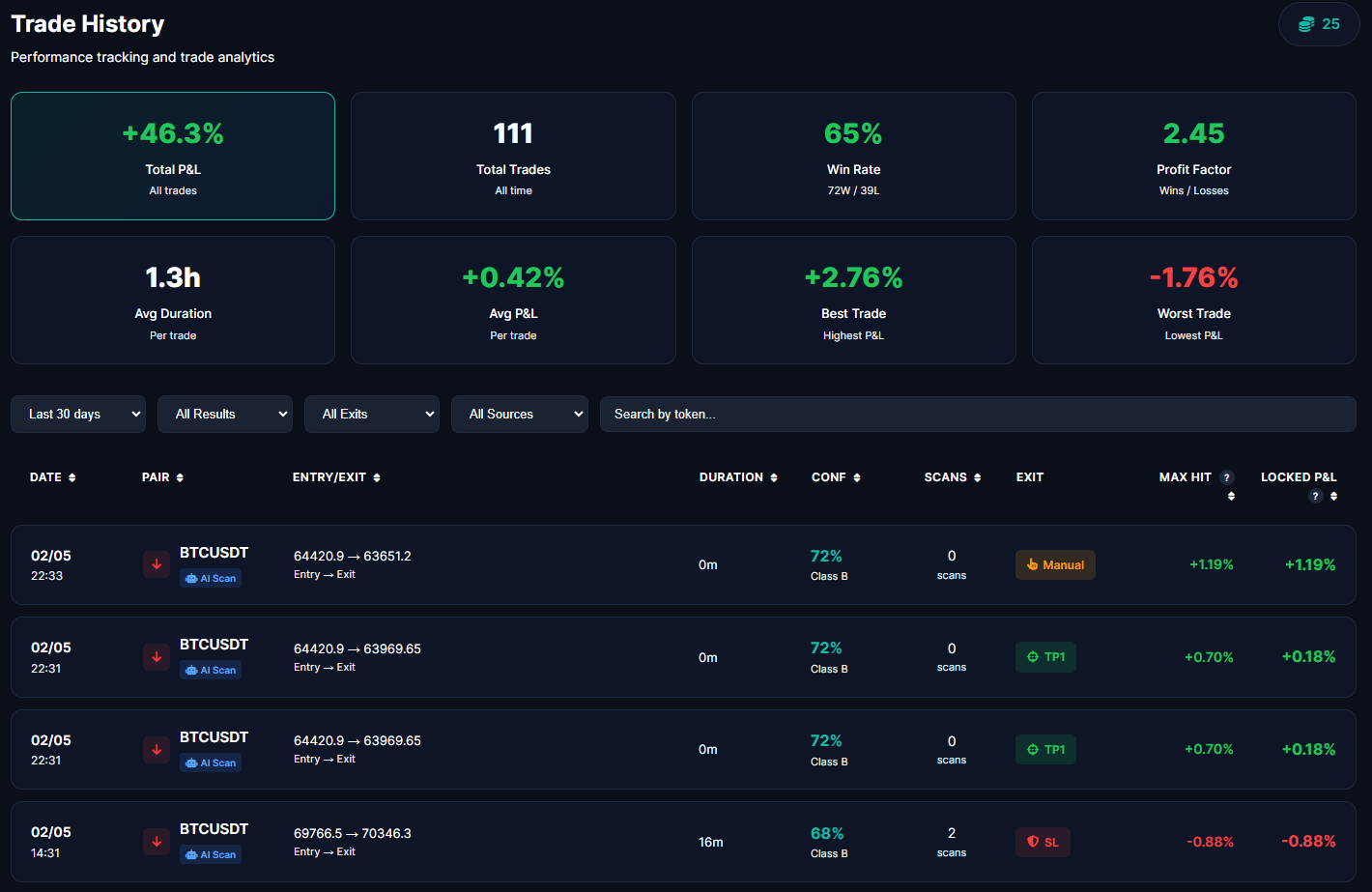
Theory is useful, but results are what matter. ChartsTrack's trade history dashboard shows you the cumulative impact of AI-managed exit timing on your actual trading performance:

  • Win rate: See how the combination of TP1 profit locking and early structure break exits affects your overall win percentage
  • Total P&L: Track your cumulative profit and loss across all AI-monitored trades, broken down by exit type (TP1, TP2, SL, early exit)
  • Profit factor: The ratio of gross profit to gross loss. A profit factor above 1.5 indicates strong edge. AI-managed exits typically improve profit factor by reducing the average loss size
  • Average duration: How long your trades run on average. Faster exits on losers and patient holds on winners should create an asymmetric duration pattern where winners run longer than losers
  • Best vs worst trade: See the range of outcomes. With disciplined exits, your worst trades should be significantly smaller than your best trades, confirming positive asymmetry

The history dashboard gives you the data to evaluate whether AI-managed exits are actually improving your results compared to your previous manual exit approach. Numbers do not lie.

ChartsTrack trade history dashboard showing performance metrics including win rate, P&L, and profit factor

Common Questions About Exit Timing

When should I exit a crypto trade?

You should exit a crypto trade when one of these conditions is met: your take profit target is hit, your stop loss is triggered, or the original trade thesis is invalidated by a change in market structure. ChartsTrack's AI monitors all three conditions continuously and provides HOLD, EXIT, or MOVE_SL recommendations after every scan, so you always have a data-driven basis for your exit decision rather than relying on gut feeling or emotion.

How does AI know when to exit a trade?

ChartsTrack's AI re-analyzes both your higher timeframe and lower timeframe charts at every scan interval (as frequently as every 5 minutes). It evaluates trend integrity, pattern development, support and resistance reactions, and momentum indicators to determine whether the trade thesis remains valid. When confidence drops significantly or a structural break is detected, the AI recommends exit before price reaches your stop loss, potentially saving significant capital.

What is the biggest mistake traders make with exit timing?

The biggest exit timing mistake is asymmetric treatment of winners and losers. Most traders cut winning trades early out of fear of giving back profits, while holding losing trades too long hoping for a reversal. This results in small wins and large losses -- the exact opposite of what profitable trading requires. AI-managed exits solve this by applying consistent, emotion-free logic to every exit decision, ensuring losers are cut quickly and winners are given room to run.

Related Articles

Master every aspect of AI-powered trade management

Let AI Manage Your Trade Exits

Continuous monitoring, confidence tracking, structure break detection, and automatic profit locking. Make exit decisions based on data, not emotions.