Honest Entry Analysis: Why ChartsTrack Shows Both Pros and Cons

Most signal providers only show you the bullish case. ChartsTrack takes a fundamentally different approach by presenting both reasons for and reasons against every trade, giving you complete transparency for better crypto trading decisions.

The Problem with One-Sided Trading Signals

The crypto signal industry has a transparency problem. The vast majority of signal providers, Telegram groups, and trading tools present only the optimistic side of every trade setup. You see the entry level, the profit targets, maybe a quick note about confluence, and then a confident "BUY" or "SELL" call. What you almost never see are the reasons why the trade might fail.

This one-sided presentation creates a dangerous false confidence. When every signal looks like a guaranteed winner on paper, traders naturally oversize their positions, skip proper risk management, and feel blindsided when trades go against them. The reality is that every single chart in existence has both bullish and bearish signals present simultaneously. Ignoring the bearish signals does not make them disappear. It just means you are not prepared when they play out.

ChartsTrack was built on a different philosophy. Our AI trade assessment shows you everything it sees on both timeframes, the good and the bad, the confluence and the contradictions. This honest entry analysis approach means you enter every trade with eyes wide open, fully aware of the risks alongside the opportunities. The result is better position sizing, more realistic expectations, and ultimately better trading outcomes over time.

Both Sides

Reasons For and Against: The Complete Picture

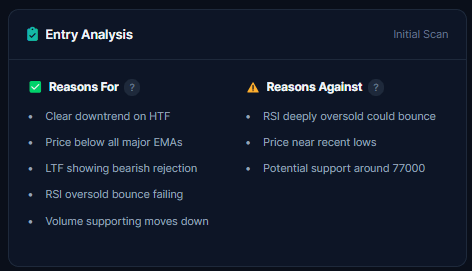
Every trade setup that ChartsTrack generates includes two clearly separated sections: Reasons For the trade and Reasons Against the trade. This is not a minor footnote or a brief disclaimer buried at the bottom. These are prominently displayed sections that form a core part of the honest trade analysis.

The Reasons For section outlines every bullish signal the AI detected across both timeframes. These might include trend alignment between HTF and LTF, strong support zone confluence, bullish candlestick patterns, positive momentum indicators, favorable market structure, or clean order block reactions. Each reason is specific and references what the AI actually observed on the chart, not generic boilerplate text.

The Reasons Against section is equally detailed. It lists every bearish or cautionary signal present on the chart. These might include nearby resistance levels, divergence on momentum indicators, declining volume, broader market weakness, unfilled fair value gaps in the opposite direction, or proximity to major liquidation zones. Again, each reason is chart-specific and backed by what the AI actually detected in its multi-timeframe analysis.

  • Reasons For — every bullish signal and confluence point the AI detected on both HTF and LTF
  • Reasons Against — every bearish signal, risk factor, and cautionary indicator present on the chart
  • Balanced ratio — the relationship between for and against directly determines the confidence score
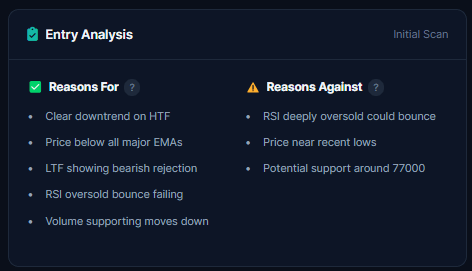
ChartsTrack entry analysis showing detailed reasons for and against a crypto trade setup
Real Example

Another Trade Assessment: Different Chart, Same Honesty

Transparent trading signals are not a feature you apply selectively. Every single analysis that ChartsTrack produces receives the same honest treatment regardless of how strong or weak the setup appears. Here is another real example showing how the AI trade assessment handles a different chart with its own unique combination of bullish and bearish factors.

Notice how the Reasons Against section is never empty. Even on the strongest setups with excellent multi-timeframe confluence, there are always factors working against the trade. Perhaps the broader market is showing weakness. Perhaps there is a significant resistance level nearby. Perhaps volume is not confirming the price movement. The AI identifies and reports these factors because pretending they do not exist does not help you as a trader.

This consistency is what builds genuine trust between the analysis tool and the trader. After using ChartsTrack for several trades, you develop an intuitive understanding of what a "clean" setup looks like (many reasons for, few against) versus a "messy" setup (roughly equal reasons on both sides). This pattern recognition is incredibly valuable for improving your own chart reading skills over time, turning the AI from a signal provider into a genuine learning tool for crypto entry analysis.

  • Every chart gets honest treatment — no cherry-picking or optimistic bias
  • Reasons Against are never empty — even strong setups have counterfactors
  • Chart-specific observations — no generic filler, everything references actual price action
Second example of honest entry analysis showing pros and cons for a different crypto trade

The Confidence Scoring System: From Reasons to Numbers

The honest entry analysis is not just qualitative. ChartsTrack converts the balance between reasons for and against into a quantitative confidence score that gives you an immediate, at-a-glance assessment of setup quality. This confidence scoring system creates a direct mathematical relationship between the transparency of the analysis and the strength of the recommendation.

The confidence score is a quality rating, not a win rate prediction. It is organized into four classes:

  • Class A (80%+ confidence) — High conviction setups. Multiple confluences across both timeframes, strong alignment between HTF trend and LTF momentum, clean structure, and only minor concerns. These setups warrant your largest position sizes.
  • Class B (70-79% confidence) — Solid setups with clear pattern or level confirmation. More reasons for than against, but the opposing signals carry meaningful weight. Valid and tradeable with slightly reduced position size compared to Class A.
  • Class C (60-69% confidence) — Speculative setups with mixed signals. Something is visible on the chart but confluence is weaker. These can be traded with smaller position sizes and tighter risk management. Some traders skip Class C setups entirely.
  • Class D (below 60% confidence) — Marginal setups with significant concerns. The reasons against outweigh the reasons for. In most cases, the AI returns a No Trade result at this level rather than pushing you into a weak setup.

Below 60% confidence, the AI typically returns a No Trade result. This threshold ensures that ChartsTrack never pushes you into a trade where the honest assessment does not support entry, regardless of how eager you might be to trade.

No Trade

When the AI Says "No Trade": Honesty Over Revenue

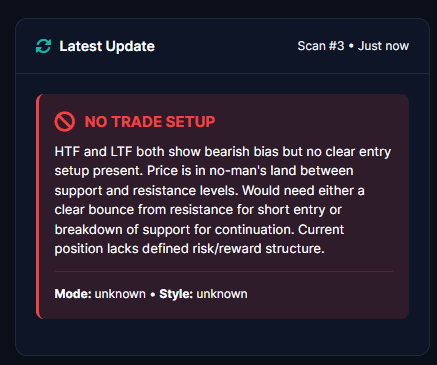
This is perhaps the most important feature of ChartsTrack's honest trade analysis: the ability to say no. When the AI analyzes a chart and determines that the risks outweigh the opportunities, it returns a clear "No Trade" assessment instead of forcing a marginal setup to justify the analysis.

The No Trade result is not a blank screen or a vague "try again later" message. It includes a detailed explanation of exactly why no valid trade setup exists on the current chart. The AI explains what it looked for and what it found lacking. Perhaps the market structure is unclear with no definitive trend direction. Perhaps the HTF and LTF are telling conflicting stories. Perhaps the price is stuck in a tight range with no clean entry opportunities. Perhaps there are too many strong resistance levels immediately above a potential long entry.

From a business perspective, it would be more profitable for ChartsTrack to find a trade on every chart. More setups means more credits consumed means more revenue. But the entire philosophy behind honest entry analysis depends on the AI being willing to say "I do not see a good trade here" when that is the truth. Anything less would undermine the trust that makes transparent trading signals valuable in the first place.

  • No credit charged — you are never penalized for honest market conditions
  • Detailed reasoning — specific explanation of why no setup exists
  • Capital protection — preventing bad trades is as valuable as finding good ones
  • Retry later — market conditions change, come back when structure clarifies
ChartsTrack No Trade assessment showing detailed reasons why no valid trade setup was found

How to Use Honest Analysis in Your Trading

Having both reasons for and against a trade is only valuable if you know how to incorporate that information into your decision-making process. Here are three practical ways to use ChartsTrack's transparent trading signals to improve your crypto trading outcomes:

1. Adjust Your Position Size Based on Confidence Class

The confidence score directly translates to position sizing. A Class A setup at 90% confidence might warrant your full standard position size because the reasons for overwhelmingly outweigh the reasons against. A Class B setup at 78% might justify 70% of your standard size. A Class C setup at 68% should probably be traded at 50% or less of your standard size, if you choose to trade it at all. This graduated approach ensures that your capital allocation reflects the actual risk profile of each individual trade rather than treating every signal as equal.

2. Set Realistic Profit Expectations

When you see 4 reasons against a trade, you should expect a bumpier ride to your targets compared to a setup with only 1 reason against. The reasons against section often highlights specific price levels or conditions that could cause temporary pullbacks or stalls. Knowing these ahead of time lets you avoid panic-selling during normal trade development and maintain discipline through expected turbulence.

3. Prepare Exit Criteria from the Reasons Against

The reasons against a trade are not just risk warnings. They are also potential exit triggers. If one of the reasons against your long trade is "declining momentum on the 4H RSI," and during monitoring you see that RSI continue declining rather than stabilizing, that specific reason against has now become an active threat. Use the reasons against as a checklist of conditions to monitor during the trade, and consider exiting if multiple reasons against begin playing out simultaneously.

Never Ignore the Reasons Against

The Reasons Against section exists to protect your capital. It is tempting to glance at a high confidence score and skip reading the bearish factors, but those factors represent real risks that the AI identified on your chart. Traders who consistently read and internalize both sides of the analysis make better position sizing decisions, experience fewer emotional surprises, and maintain better long-term profitability. Treat the Reasons Against as required reading before every trade, not optional fine print.

The Three Pillars of Honest Analysis

How transparent AI trade assessment transforms your crypto trading approach.

Full Transparency

Every bullish and bearish signal the AI detects is reported openly. No hidden data, no optimistic filtering, no cherry-picked setups. You see exactly what the AI sees on both timeframes, empowering you to verify the analysis against your own chart reading and build genuine confidence in your trading decisions.

Risk Awareness

Knowing the reasons against a trade before you enter transforms your risk management. Instead of discovering problems reactively when price moves against you, you anticipate potential challenges proactively and prepare your response in advance. This awareness leads to calmer, more disciplined trading even in volatile crypto market conditions.

Better Decisions

When you consistently see both sides of every trade, your own chart reading skills improve dramatically. You learn to identify bearish signals you previously overlooked, develop more nuanced pattern recognition, and build the kind of balanced analytical mindset that separates consistently profitable traders from the crowd.

Frequently Asked Questions About Honest Trade Analysis

Understanding how transparent entry analysis helps you make better crypto trading decisions.

Why does ChartsTrack show reasons against taking a trade?

ChartsTrack believes that honest trade analysis requires showing both sides. Every chart has bullish and bearish signals simultaneously. By presenting the reasons against a trade alongside the reasons for it, traders can make informed decisions with full awareness of the risks. This transparency helps traders adjust position sizes, set realistic expectations, and avoid the overconfidence that comes from only seeing the bullish case. It is the difference between a signal service that tells you what you want to hear and an analysis tool that tells you what you need to know.

How does the confidence scoring system work?

The confidence score is a quality rating, not a win rate prediction. Class A setups (80%+ confidence) have strong multi-timeframe alignment with multiple confluences and minimal concerns. Class B setups (70-79%) are solid with clear pattern or level confirmation. Class C setups (60-69%) are speculative with mixed signals that should influence your position sizing. Class D (below 60%) are marginal — the AI typically returns a No Trade result at this level rather than pushing a weak setup.

What happens when the AI says No Trade?

When the AI determines that the risks outweigh the opportunities on a chart, it returns a No Trade assessment with a detailed explanation of why no valid setup exists. This could be due to unclear structure, conflicting timeframes, proximity to major resistance, low volume, or too many bearish signals. Importantly, no credit is charged for No Trade results, so you are never penalized for honest market conditions where no high-probability opportunity exists.

Should I skip trades with many reasons against?

Not necessarily. The number of reasons against matters less than their severity and the overall confidence score. A trade with 3 minor reasons against (such as slightly declining volume or approaching a minor resistance level) may still be an excellent setup if it has 6 strong reasons for. However, a trade with 2 severe reasons against (such as major trend divergence or a key support break on HTF) deserves serious caution regardless of how many reasons for are present. Use the confidence score as your primary guide and read the specific reasons against to understand the quality of risk, not just the quantity.

Related Articles

Explore more about risk-aware crypto trading and ChartsTrack's analysis tools.

Experience Honest AI Analysis

See both sides of every trade with transparent pros, cons, and confidence scoring. Start free with 2 credits and discover what honest chart analysis looks like.